

Have you ever ordered a t-shirt online, only to find it fits nothing like expected? You’re not alone. 61% of apparel returns stem from poor fit caused by sizing inconsistencies across brands. Whether you’re shopping for trendy graphic tees or humorous apparel, nailing the right size saves you from uncomfortable fits and costly returns. This guide walks you through simple measurement techniques, size chart interpretation, and fit style choices so you can confidently select t-shirts that look great and feel amazing.
Table of Contents
- What You Need Before You Start: Tools And Conditions
- Step 1: How To Measure Yourself For A T-Shirt
- Step 2: Understanding Fit Styles And Size Chart Interpretation
- Common Mistakes And Troubleshooting When Choosing Your T-Shirt Size
- Expected Outcomes And How To Know You Got The Right Size
- Bonus Tips: Sizing Considerations For Gifting And Group Orders
- Explore Trendy Graphic Tees With Confidence
- Frequently Asked Questions About T-Shirt Sizing
Key takeaways
| Point | Details | |-------|---------|| | Accurate measurements matter | Measure chest circumference and body length correctly to match size charts and avoid poor fits. | | Fit styles guide your choice | Regular, slim, and oversized fits serve different style preferences and body shapes. | | Use both body and garment data | Comparing your measurements with garment dimensions on size charts yields the most accurate size selection. | | Account for fabric behavior | Expect 3-5% cotton shrinkage after washing and adjust size choice accordingly. | | Size up when uncertain | Choosing one size larger reduces return risk and improves overall comfort. |
What you need before you start: tools and conditions
Before diving into measurements, gather the right tools and set up ideal conditions. You’ll need a soft fabric measuring tape, the kind tailors use. Avoid metal or rigid tapes because they don’t conform to body curves. Keep a flat, clean surface nearby to lay out a t-shirt you already own and love wearing.
Have that well-fitting t-shirt ready. It serves as your reference garment, helping you compare measurements when evaluating new purchases online. If you’re unsure about your preferred fit style, try on a few shirts in your closet. Do you like snug, tailored looks or relaxed, roomy vibes? Knowing this preference tailors your size choice.
Ideal conditions improve accuracy. Measure yourself in front of a mirror wearing minimal, form-fitting clothing. Stand naturally with relaxed posture. Avoid holding your breath or sucking in your stomach. These habits skew results and lead to sizes that feel tight when you’re just being yourself.
Pro Tip: Take measurements at the same time of day, preferably morning, when your body hasn’t expanded from meals or activity. Consistency matters for reliable results.
| Tool/Condition | Purpose | |----------------|---------|| | Soft fabric measuring tape | Accurately measures body curves without distortion | | Well-fitting reference t-shirt | Provides garment dimensions for comparison | | Mirror | Ensures tape placement is level and correct | | Relaxed posture | Captures true body measurements without artificial adjustments |
Step 1: how to measure yourself for a t-shirt
Start with your chest circumference. Wrap the tape measure around the fullest part of your chest, under your armpits and across your shoulder blades. Keep the tape parallel to the floor. Add two fingers of space between the tape and your body for comfortable ease. This extra room prevents a skin-tight fit. Record this measurement in inches.
Next, measure body length. Find the highest point of your shoulder where a t-shirt seam would sit. Run the tape straight down to where you want the hem to fall, typically at hip level or slightly below. This measurement helps you avoid shirts that are too short or excessively long.
Now measure a t-shirt you love. Lay it flat on a table with no wrinkles. Measure chest width from underarm seam to underarm seam, then double that number for total chest circumference. Measure body length from the top of the shoulder seam to the bottom hem. Measuring a t-shirt laid flat that fits well is often more accurate for choosing new t-shirts online.
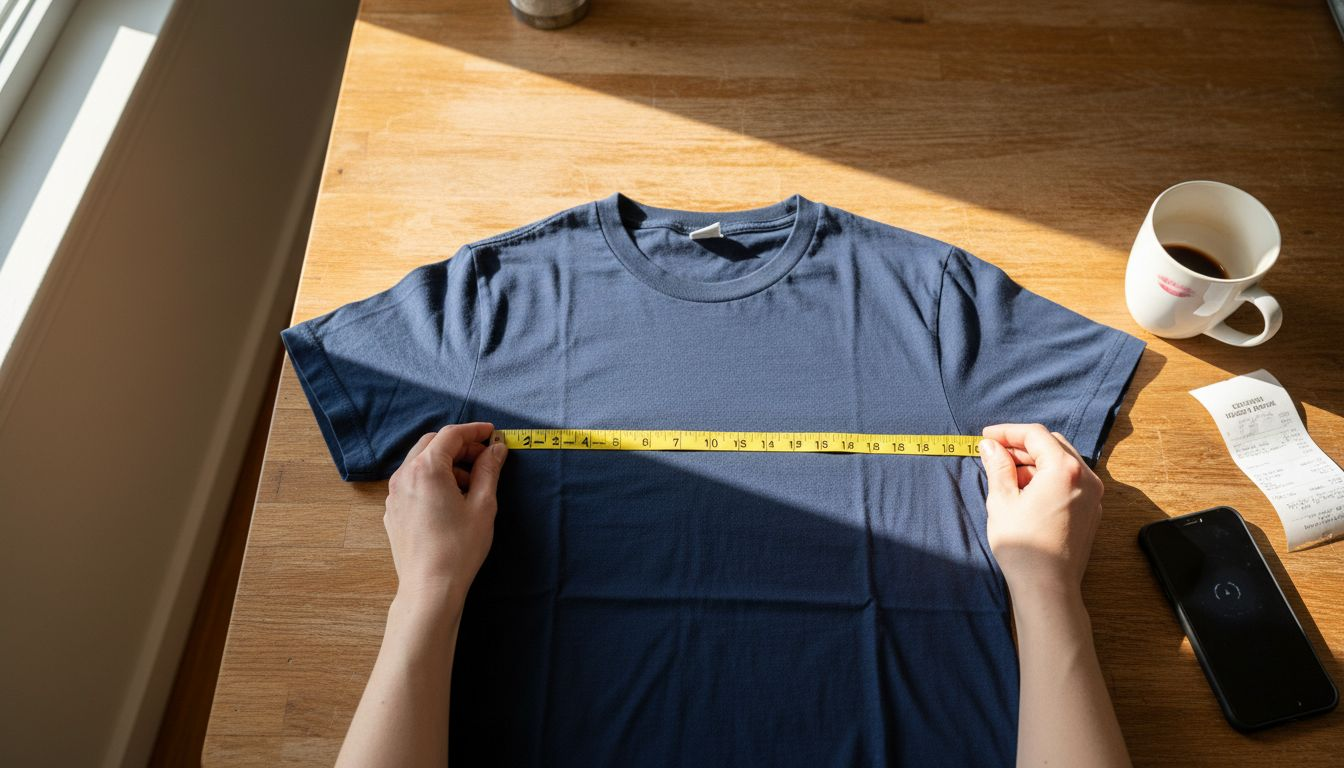
Optionally, measure sleeve length if you’re particular about arm coverage. Start at the center back of your neck, run the tape over your shoulder, and down to your wrist. This dimension matters for fitted styles but less so for standard tees.
Pro Tip: Write down all measurements immediately. Memory fades fast, and accurate numbers are your ticket to choosing graphic tees that fit like they were made for you.
- Stand naturally and wrap the tape around your chest under your armpits.
- Keep the tape parallel to the ground and add two fingers of ease.
- Measure from shoulder seam to desired hem length for body length.
- Lay a well-fitting tee flat and measure chest width, then double it.
- Record sleeve length if you want precise arm coverage.
| Measurement Type | How to Measure | Typical Range (Men) | Typical Range (Women) |
|---|---|---|---|
| Chest circumference | Around fullest part, under arms | 36-48 inches | 32-42 inches |
| Body length | Shoulder seam to hem | 28-32 inches | 24-28 inches |
| Chest width (flat garment) | Underarm to underarm, doubled | 18-24 inches | 16-21 inches |
| Sleeve length | Center back neck to wrist | 32-36 inches | 30-34 inches |
Step 2: understanding fit styles and size chart interpretation
Fit styles dramatically change how a t-shirt looks and feels. Regular fit offers a comfortable, classic silhouette with moderate ease around the chest and waist. Slim fit is tailored closer to the body, emphasizing shape without clinging. Oversized fit is trendy and relaxed, providing extra room everywhere for a laid-back vibe. Knowing which style you prefer narrows your size options fast.
Unisex t-shirts run larger and boxier than women’s cuts. Women shopping for unisex tees should size down one or two sizes for a better fit. A unisex medium often fits like a women’s large or extra-large. This adjustment is crucial when exploring types of graphic tees that come in unisex sizing.
Reading size charts requires comparing both your body measurements and your reference garment dimensions. Size charts combining body measurements with garment measurements provide the clearest guidance for online shoppers, reducing return rates. Match your chest circumference to the size chart’s chest range, then verify the listed garment chest width and length align with your reference tee.
Cotton fabric shrinks 3-5% after the first wash. If a size chart shows a chest width of 20 inches, expect it to measure closer to 19 inches post-wash. When your measurements land right at the upper edge of a size range, consider the next size up to account for shrinkage.
Pro Tip: If you’re between sizes, always choose larger. Extra fabric is easier to style than a shirt that pulls across your chest or rides up your torso.
| Fit Style | Characteristics | Best For |
|---|---|---|
| Regular | Moderate ease, classic silhouette, versatile | Everyday casual wear, all body types |
| Slim | Tailored closer to body, emphasizes shape | Athletic builds, fitted style preferences |
| Oversized | Extra room everywhere, trendy relaxed look | Streetwear fans, comfort-first wearers |
Common mistakes and troubleshooting when choosing your t-shirt size
Choosing sizes too small is the top mistake. Tight fits restrict movement and feel uncomfortable all day. If you’re uncertain, size up. Larger shirts provide breathing room and reduce the chance you’ll need to return them. Comfort beats a snug look every time.
Misunderstanding unisex sizing trips up many women. Unisex tees are designed with a straight, boxy cut that doesn’t accommodate curves. Women often need to size down significantly or seek women’s-specific styles for a flattering fit. Ignoring this difference leads to shapeless results.
Ignoring fabric shrinkage causes post-wash disappointment. A shirt that fits perfectly out of the package might feel tight after one laundry cycle. Always account for 3-5% shrinkage in cotton blends and pure cotton tees. Pre-shrunk fabrics minimize this issue but don’t eliminate it entirely.
Measuring chest without adequate ease creates a skin-tight fit. Remember to add two fingers of space when wrapping the tape. This small adjustment makes a huge difference in wearability. You want to move, breathe, and sit comfortably without fabric strain.
“Incorrect size selection leads to 61% of apparel returns, highlighting the importance of accurate sizing guides.”
Pro Tip: When buying trendy graphic tees, check customer reviews for fit feedback. Real-world experiences often reveal if a brand runs large, small, or true to size, helping you avoid sizing mistakes and find the perfect match.
- Choosing too small restricts movement and causes discomfort throughout the day.
- Misunderstanding unisex sizing leaves women with boxy, unflattering fits.
- Ignoring shrinkage results in tees that feel tight after washing.
- Measuring without ease creates uncomfortably snug fits around the chest.
- Skipping customer reviews misses valuable real-world sizing insights from other shoppers.
- Relying solely on generic size labels (S, M, L) without checking actual measurements leads to inconsistent fits across brands.
For more guidance, explore trendy graphic clothing tips to refine your selection process and boost satisfaction.
Expected outcomes and how to know you got the right size
The right fit feels comfortable the moment you put it on. You should have slight ease in the chest, allowing you to move your arms freely without fabric pulling. The hem should hit at your preferred length, whether that’s mid-hip or slightly lower. Shoulder seams should sit right at the edge of your shoulders, not drooping down your arms or riding up your neck.
Most common US t-shirt sizes ordered are Large at 32%, Medium at 28%, and XL at 19%. If you fall into one of these ranges based on your measurements, you’re in good company. These sizes represent the sweet spot for many shoppers, balancing comfort and style.
Proper fit reduces return rates and improves wear satisfaction. When you nail your size, you’ll reach for that tee again and again. It becomes a wardrobe staple, not a closet orphan. Post-wash fit should remain consistent, accounting for minor shrinkage. If you sized up slightly to accommodate cotton shrinkage, the shirt will settle into an ideal fit after laundering.
- Chest area has slight ease, allowing free arm movement without pulling.
- Hem falls at your desired length, typically mid-hip or slightly below.
- Shoulder seams align with the edge of your shoulders, not sagging or tight.
- Post-wash fit remains comfortable after accounting for 3-5% shrinkage.
- You feel confident and relaxed wearing the tee in various settings.
When choosing graphic tee gifts, apply these same fit benchmarks to ensure the recipient enjoys wearing your thoughtful present.
Bonus tips: sizing considerations for gifting and group orders
Buying t-shirts as gifts requires extra care. If possible, discreetly check the recipient’s current wardrobe for size labels or ask a close friend or family member. Refer precisely to size charts matching the recipient’s estimated measurements. This step minimizes guessing and maximizes the chance your gift fits well.
Opt for slightly larger sizes when uncertain. A roomier tee is easier to wear casually than one that’s too tight. Oversized fits are trendy right now, so going up a size often works in your favor. The recipient can always layer or style a larger shirt, but a small one just sits unused.
Confirm fit style preference before purchasing. Some people love fitted tees that show their shape, while others prefer relaxed, roomy styles. A quick conversation or observation of their usual clothing can guide your choice. When in doubt, regular fit is the safest middle ground.
For group orders, align sizes with common US distribution percentages: 32% Large, 28% Medium, 19% XL. This data helps you estimate quantities for events, teams, or promotional giveaways. Always offer a range of sizes from Small to 2XL to accommodate diverse body types.
- Discreetly check recipient wardrobe or ask trusted contacts for size clues.
- Choose one size larger if uncertain to avoid overly tight fits.
- Confirm whether the recipient prefers fitted or relaxed styles before buying.
- For group orders, stock sizes based on typical US distribution (32% L, 28% M, 19% XL).
Explore the graphic tee gifts guide for more ideas on selecting presents that delight. Discover benefits of gifting graphic tees to understand why these items make such popular, appreciated presents. For younger recipients, check out kids graphic tee ideas to find age-appropriate styles and sizing tips.
Explore trendy graphic tees with confidence
Now that you understand how to measure accurately and interpret size charts, you’re ready to shop trendy graphic and humorous t-shirts that fit perfectly. At 3 Wizard Clothing, we offer a curated selection of expressive, fun apparel designed for young adults and families who value comfort and style.
Explore featured tees like the Keep It Simple Sneaker Tee for effortless everyday vibes or the Hello Autumn Tee for cozy seasonal charm. Our detailed size charts combine body and garment measurements, making it easy to find your ideal fit. Shop with confidence knowing you have the knowledge to avoid returns and enjoy shirts that feel as good as they look.
Frequently asked questions about t-shirt sizing
Common questions about t-shirt sizing often prevent shoppers from making confident purchases. This section addresses doubts about shrinkage, unisex versus women’s sizing, measurement techniques, and what to do when you’re between sizes. For additional tips on selecting the perfect graphic tee as a gift, visit our graphic tee gift tips guide.
How can I account for t-shirt shrinkage when buying online?
Expect 3-5% shrinkage for cotton tees and size up slightly to accommodate this change. Always check product fabric details for shrinkage guidance, as blends and pre-shrunk fabrics behave differently. Washing in cold water and air drying minimizes shrinkage but doesn’t eliminate it entirely.
What are the differences between unisex and women’s t-shirt sizing?
Women should size down one to two sizes in unisex tees for a better fit. Unisex tees run larger and feature a boxier cut compared to women’s styles, which are tailored to accommodate curves. If you prefer a more fitted silhouette, seek women-specific sizing whenever possible.
How do I measure a t-shirt that fits me well?
Lay the t-shirt flat on a surface with no wrinkles. Measure chest width from underarm seam to underarm seam and double it for total circumference. Measure body length from the top of the shoulder seam to the bottom hem to capture the full garment dimensions.
What should I do if I am between two sizes?
Choose the larger size for more comfort and to reduce return risk. Oversized styles tolerate size upsizing better than slim fits. Extra fabric can always be styled casually, but a too-small shirt offers no flexibility for adjustments.
Recommended
- Kids Graphic Tee Tips 2026: 45% Prefer Humorous Styles – 3 Wizard Clothing
- 6 Types of Graphic Tees Every Young Adult Should Know – 3 Wizard Clothing
- Role of graphic tees in youth style: 53% see them as essential – 3 Wizard Clothing
- How to Choose Graphic Tee Gifts for Every Occasion – 3 Wizard Clothing


