

Pick fleece when you want maximum warmth and a plush, cozy hand feel. Pick French terry when breathability, structure, and clean printing matter more. One way to put it simply: fleece wins cold-weather layers and camping trips, French terry wins year-round hoodies and printed merch that needs to look sharp for years.
TL;DR:
- French terry provides better breathability and is ideal for year-round hoodies and printed merchandise that require fine detail and sharpness.
- Brushed fleece offers greater warmth and insulation due to its fluffy nap, making it more suitable for winter outerwear and outdoor gear.
- GSM ratings are crucial: midweight French terry (260-320 GSM) suits most seasonal hoodies, while heavier fleece (above 300 GSM) enhances thermal performance.
- Care differs: fleece should be air-dried to prevent nap flattening, whereas French terry can be tumble-dried on low heat with reshaping.
- For graphic printing, French terry’s smooth surface ensures crisp, detailed designs, while fleece supports textured effects and high-loft treatments.
Table of Contents
- What Is French Terry Fabric?
- What Is Brushed Fleece Fabric?
- Fleece vs French Terry Comparison: The Full Breakdown
- How to Choose Between Fleece and French Terry
- Washing and Drying Fleece and French Terry the Right Way
- Which Fabric Prints Better for Graphic Apparel?
- Bottom Line: Fleece or French Terry?
- Why 3 Wizard Clothing Leans Toward Heavier French Terry
- See Both Fabrics on Real Hoodies at 3 Wizard Clothing
- Sources
What Is French Terry Fabric?
French terry is a knit fabric with a smooth outer face and small, unbrushed loops on the inside. Those loops are the whole story. They trap a little air for warmth but leave the surface open enough to breathe, which is why French terry feels lighter and less bulky than a heavy fleece pullover even at similar thickness. According to Phrase Studios’ breakdown of hoodie fabrics, that loopback interior is what separates French terry from both fleece and true toweling terry.
Speaking of which: French terry garment fabric has nothing to do with the woven loop fabric used in bath towels. Terrycloth on Wikipedia covers that different, woven towel material. Confusing the two is a common mistake, but they’re built on entirely different looms for entirely different jobs.
Weight tells you a lot about how a French terry piece will behave:
- Light weight drapes well and suits warm-weather sweatshirts and T-shirt-weight hoodies.
- Midweight is ideal for everyday hoodies, balancing structure and breathability.
- Heavyweight is substantial enough for standalone outerwear without fleece’s bulk.
Some suppliers also sell a lightly brushed version, sometimes marketed as “fleece French terry.” It softens the interior slightly without going full nap, sitting between standard French terry and true brushed fleece. That flat, tight face is also exactly why French terry takes screen printing, DTF, and fine embroidery so well. Ink and thread grip a smooth surface far more evenly than a fuzzy one.
What Is Brushed Fleece Fabric?
Fleece starts life as a knit loop fabric, not unlike French terry, but then goes through a mechanical brushing process that breaks the loops into thousands of tiny fibers. That napped surface is what makes fleece feel plush, and it’s also what makes it warmer. The brushed fibers create a fuzzy layer that traps more air than French terry’s tight loops, which is why brushed fleece tends to outperform a comparable-weight French terry on straight insulation, according to Phrase Studios.
“Fleece” isn’t one fabric. It’s a family, and the differences matter at checkout:
- Polar fleece is a classic midweight fleece commonly used in everyday sweatshirts and jackets.
- Microfleece is lighter and thinner, suitable for base layers where reduced bulk is desired.
- Sherpa fleece is a heavy, curly-pile fabric designed for maximum warmth, often used in jacket linings.
- Anti-pill fleece is treated or blended to reduce surface fuzzing that can occur with cheaper fleece over time.
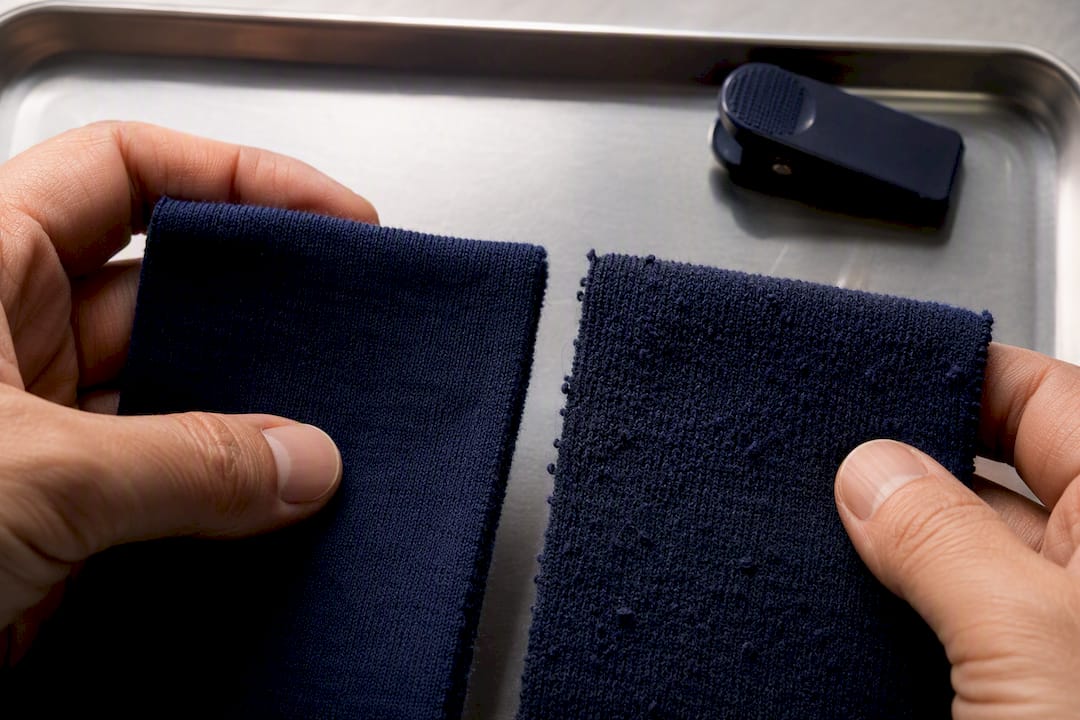
Fleece’s upside is obvious: it’s warm for its weight and dries fast after a light wash. The downside shows up over time. Cheaper fleece pills, meaning small fiber balls form on the surface after repeated washing and wear, and its nap doesn’t hold fine print detail the way a flat knit does. Thygesen Apparel’s overview of fleece notes that higher-loft fleece traps more heat but pills more and dries slower than French terry, which is the trade-off in one sentence.
Fleece vs French Terry Comparison: The Full Breakdown
Here’s the mechanism most people miss: warmth isn’t mainly about weight. It’s about surface treatment. A brushed 280 GSM fleece can feel warmer than an unbrushed 320 GSM French terry, because the nap traps air that loops simply don’t. Thermal performance comes down to napping versus loop structure and density working together, not GSM alone.
Breathability runs the opposite direction. French terry’s open loop structure lets air move through the fabric, which matters if you’re wearing a hoodie during activity or layering it under a jacket where sweat needs somewhere to go. Fleece’s dense nap holds heat in, which is great on a chairlift and less great on a fast walk to the car in 60-degree weather.
| Attribute | French Terry | Brushed Fleece |
|---|---|---|
| Warmth | Moderate; better with higher GSM | High even at moderate GSM, thanks to nap |
| Breathability | High; open loop structure | Lower; dense nap traps heat |
| Typical GSM range | 260 to 380 | 200 to 400+ (varies by type) |
| Durability / pilling | Ages well; low pilling risk | Prone to pilling unless anti-pill treated |
| Care / drying time | Dries faster; reshape damp | Dries slower; air-dry preferred |
| Printing / decoration | Excellent for screen print, DTF, embroidery | Better for high-loft textures, chenille, puff |
| Typical uses | Year-round hoodies, printed merch, loungewear | Winter layers, outerwear linings, camp gear |
GSM guidance for shopping: if you’re buying a hoodie meant to work across multiple seasons, look for French terry with a midweight density. For genuinely cold winter conditions, a heavier brushed fleece or sherpa lining typically provides better insulation per unit weight.
Durability plays out differently, too. French terry tends to age more gracefully because there’s no nap to flatten or pill. Fleece, especially the cheaper polar fleece variants, can look worn after a season of regular washing unless it’s an anti-pill or Polartec-style construction, which factory-grade blends handle better than budget options, as Thygesen Apparel points out.
Decoration compatibility follows the same logic driving warmth: a flat surface holds fine detail, a napped one holds texture. MAVYQ’s fabrication guide rates French terry higher for screen print, DTF, and fine embroidery, and fleece higher for chenille patches, puff print, and other high-loft treatments where the nap actually helps rather than hurts.
How to Choose Between Fleece and French Terry
Before you add anything to cart, run through a short list of questions. They take thirty seconds and save you from a return.
- What’s the primary use? Commuting and daily wear favor French terry; ski trips and camping favor fleece.
- Will you layer it? French terry’s lower bulk works better under a jacket; fleece often works as the jacket.
- What GSM does the product page list? No number listed is a yellow flag, especially on unbranded storefronts.
- What’s the fiber content? Cotton-poly French terry blends drape differently than 100% cotton; check before you buy for print work.
- Are you decorating it? Flat prints and embroidery detail need French terry; textured patches do fine on fleece.
Matching scenario to fabric gets easier once you see it laid out. A daily hoodie for mild climates wants light-to-mid French terry, roughly 260 to 320 GSM. A gym layer wants microfleece or light French terry for breathability without bulk. Custom merch with a detailed logo wants mid-to-heavy French terry, 300 to 380 GSM, for print clarity. Heavy winter outerwear wants sherpa or heavyweight polar fleece north of 300 GSM.
Watch for vague listings that just say “fleece” with no GSM, no brushing detail, and no fiber content. That’s often a sign the seller is using the word loosely to describe anything soft, which tells you nothing about how the garment will actually perform.
Pro Tip: If a product page won’t tell you the GSM or fiber blend, email the seller before you buy. A shop that can’t answer in one reply probably doesn’t know either.
Washing and Drying Fleece and French Terry the Right Way
Both fabrics reward the same basic habits: cold wash, mild detergent, and decorated garments turned inside out to protect the print. Where they split is drying.
- Fleece: Air-dry when possible. High heat flattens the nap over time and can degrade prints faster than gentle drying, a pattern MAVYQ’s fabrication guide flags directly.
- French terry: Low-heat tumble is fine, but reshaping the garment while it’s still damp keeps the drape intact and prevents the loop side from stretching out.
- Pilling fixes: A fabric shaver handles light pilling on fleece without damaging the base knit. Heavy, matted pilling usually means it’s time to replace the piece rather than keep shaving it.
Pro Tip: Wash printed hoodies less often than you think you need to. Spot-cleaning between wears extends both the nap and the print far longer than a wash-after-every-use habit.
Which Fabric Prints Better for Graphic Apparel?
If you’re buying or designing graphic hoodies, decoration method should drive the fabric decision, not the other way around. Screen printing, DTF, and fine embroidery all favor French terry’s smooth face, since the ink or thread sits on a flat, even surface instead of fighting a nap.
- Screen print and DTF: French terry, especially in the 300+ GSM range for a stable print surface.
- Fine embroidery with small text or detail: French terry, since fleece’s nap can blur crisp edges.
- Chenille, puff print, or heavy textured embroidery: fleece handles these well, and the nap actually adds visual depth.
- Before ordering in bulk, request a test print or sample swatch. Nap and finishing vary enough between suppliers that the same design can look different on two “identical” fleece rolls.
If you’re sourcing embroidery on fleece specifically, ask the supplier about backing or stabilizer. Fleece’s stretch and loft need extra support behind the stitching, or detailed logos will pucker.
Bottom Line: Fleece or French Terry?
The verdict hasn’t changed: fleece wins on warmth and plush feel, French terry wins on breathability, structure, and print quality.
Choose fleece when:
- You need maximum warmth for cold weather or outdoor gear
- You’re layering under a shell jacket rather than wearing it alone
- The design uses chenille, puff print, or heavy texture
Choose French terry when:
- You want a hoodie that works across three seasons
- You’re printing detailed graphics or fine embroidery
- Breathability during activity or daily wear matters more than raw insulation
Why 3 Wizard Clothing Leans Toward Heavier French Terry
When we’re sourcing fabric for printed hoodies, heavier loopback French terry usually wins. It holds screen prints and embroidery with less distortion over years of washing, which matters more to us than shaving a few dollars off cost with a thinner build. Fleece still earns its place in the lineup, but as a deliberate choice for pieces meant to genuinely keep someone warm, not as a default.
Read the product description closely before you buy anything, whether it’s from us or anywhere else. GSM, fiber content, and brushing detail tell you more than a marketing photo ever will. If you can get your hands on a physical sample, feel it before you commit to a bulk order.
— Josh
See Both Fabrics on Real Hoodies at 3 Wizard Clothing
You don’t have to guess which fabric fits your closet. The store carries both heavier French terry hoodies built for crisp graphic prints and brushed fleece pieces built for genuine cold-weather warmth, so you can compare the feel side by side before you buy.

If you want a lighter reference point outside our own lineup, a casual short-sleeve hooded sweatshirt shows how a lightweight French terry construction behaves in a warm-weather cut. For layering ideas once you’ve settled on a fabric, our guide to layering graphic hoodies walks through pairing weights for changing weather.
Ready to see the difference in person? Browse the current hoodie collection and check the fabric details on each product page before you check out.
Sources
- French Terry vs Fleece Hoodies: 2026 Technical Fabrication Guide – MAVYQ
- What Is Fleece Fabric? Key Benefits and Common Applications – Thygesen Apparel
- Terrycloth — Wikipedia


