

For a single custom tee or a photorealistic design, direct-to-garment (DTG) printing is the right call. For a bulk order of 25 or more shirts with bold, flat colors, screen printing almost always costs less per unit and lasts longer under heavy washing. The economic crossover sits around 24–36 pieces: below that threshold, DTG’s zero-setup cost wins; above it, screen printing’s per-unit efficiency takes over. Artwork complexity shifts that line. A four-color screen print breaks even faster than a two-color one because each color requires its own screen and setup fee.
Key Takeaways
DTG wins for small runs and complex artwork; screen printing wins for bulk orders and specialty effects, with the crossover typically falling between 24 and 36 pieces.
| Point | Details |
|---|---|
| Crossover quantity | DTG is cheaper under ~24 pieces; screen printing wins above ~36 pieces. |
| Artwork complexity | Photorealistic or gradient designs favor DTG; flat bold colors favor screen printing. |
| Fabric matters | 100% cotton suits both methods; polyester blends and dark garments shift the advantage to screen printing. |
| Durability gap | Screen prints last longer under heavy washing; DTG on proper cotton reaches roughly 30–50 wash cycles. |
| When in doubt | Request a physical sample before committing to a full run. |
Table of Contents
- How DTG vs screen printing compare across every key dimension
- How DTG printing works in practice
- How screen printing works in practice
- Costs, minimums, and turnaround: the crossover math
- Print quality: detail, color, gradients, and file prep
- Durability expectations and how to care for each print type
- Which fabrics and garment colors work best with each method
- Environmental trade-offs between DTG and screen printing
- How to decide which method fits your specific order
- What we’ve learned choosing between DTG and screen printing at 3wizardclothing
- Sources
How DTG vs screen printing compare across every key dimension
The table below maps both methods against the eight dimensions that actually drive the decision.
| Dimension | DTG | Screen Printing |
|---|---|---|
| Best for / use case | Small runs, photorealistic art, on-demand | Bulk orders, flat bold colors, specialty effects |
| Setup costs / minimums | No setup fee; no minimum | Per-screen fee per color; typically 24–36 piece minimums |
| Per-unit cost behavior | Flat regardless of quantity | Drops sharply as quantity rises |
| Artwork complexity & color limits | Unlimited colors, gradients, photos | Best at 1–4 flat colors; gradients require halftone simulation |
| Durability / wash life | Roughly 30–50 wash cycles with proper cure | Decades with correct cure; outlasts DTG under heavy use |
| Fabric compatibility | Best on 100% cotton; struggles with polyester blends | Works on cotton, polyester, and most blends |
| Turnaround time | Fast for small quantities; slows at scale | Slower setup; faster press run at high volume |
| Sustainability / waste | Less water and chemical waste; supports print-on-demand | More water and chemical use; efficient at scale if demand is certain |
A few practical takeaways from that comparison:
- Quantity alone can decide the method. Under 24 pieces, DTG is almost always cheaper in total cost. Past 36 pieces, screen printing usually wins unless the design has many colors.
- Dark garments shift the math. DTG on a black shirt requires a white underbase pass, adding time and ink cost. That step can push the crossover point lower, making screen printing competitive even at smaller quantities for dark bulk runs.
- Specialty effects are screen-printing exclusive. Foil, puff, discharge, metallic, and glow-in-the-dark inks cannot be replicated by DTG chemistry. If the design calls for any of those finishes, screen printing is the only option regardless of quantity.
- Fabric forces the decision on performance wear. Polyester-heavy athletic garments are poor candidates for DTG without special pretreatment. Screen printing handles synthetic fabrics without that constraint.
- On-demand retail favors DTG. Printing one unit at a time with no minimum order makes DTG the practical choice for personalized gifts, test products, or limited drops.
How DTG printing works in practice
Direct-to-garment printing is essentially inkjet printing on fabric. The process runs in four main steps.
- Artwork preparation. The design file is sent to a raster image processor (RIP) software, which converts it into a print-ready format. The RIP handles color management and generates a white underbase layer when needed for dark garments.
- Pretreatment. Dark or colored garments receive a liquid pretreatment spray, which bonds with the fabric fibers and allows ink to adhere properly. Light garments on 100% cotton often skip this step. Pretreatment must dry completely before printing.
- Print pass. The garment is loaded flat onto a platen and fed through the printer. The machine lays down CMYK inks (plus white underbase if required) in a single pass. A high-cotton shirt with a full-chest design typically takes 2–4 minutes per piece.
- Curing. The printed garment goes through a heat press or conveyor dryer to cure the ink. Incomplete curing is the most common cause of premature fading.
DTG excels at intricate, full-color, photographic images with no per-color setup, which is why it suits on-demand and small runs where screen setup costs would be prohibitive. Kornit Digital notes that modern DTG ink and printhead advances are narrowing the durability gap with screen printing, though screen printing still leads on heavy-use durability.
Pro Tip: Submit artwork as a high-resolution PNG with a transparent background and the color profile set to sRGB. Ask the printer for a digital proof before the run, and request a physical test print on the actual garment color if the design includes skin tones or subtle gradients.
How screen printing works in practice
Screen printing is a stencil process. Each color in the design gets its own screen, and those screens are the source of both the method’s strength and its cost structure.
- Color separation. The artwork is separated into individual color layers. A four-color design produces four film positives.
- Screen exposure. Each film positive is placed on a mesh screen coated with photosensitive emulsion and exposed to UV light. The unexposed areas wash away, leaving a stencil.
- Ink mixing and press setup. Inks are mixed to match Pantone or custom colors. Each screen is registered on the press so colors align precisely.
- Printing. A squeegee pushes ink through the mesh onto the garment. A six-color automatic press can run hundreds of shirts per hour once set up.
- Curing. Printed garments pass through a conveyor dryer at high temperature to cure the plastisol or water-based ink.
The one-screen-per-color rule is why gradients and photographs are difficult. Reproducing a gradient requires halftone dot patterns, which approximate the effect but never match the smooth transitions DTG achieves natively. What screen printing delivers instead is opacity, vibrancy, and specialty effects that DTG cannot touch: foil transfers, puff ink that raises off the fabric, discharge printing that removes dye for a soft vintage feel, and metallic inks. Those finishes require physical ink or additive layers that DTG chemistry and printheads cannot replicate.
Costs, minimums, and turnaround: the crossover math
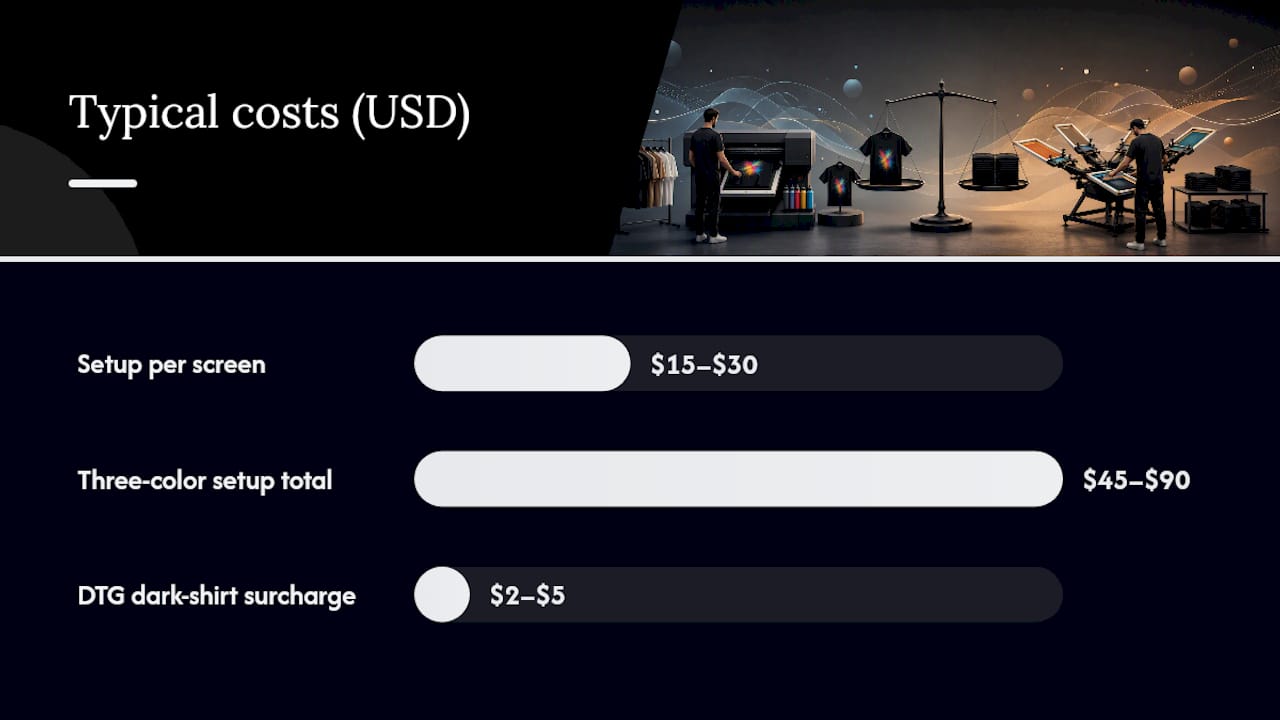
Screen printing charges a setup fee for each color screen, typically ranging from $15–$30 per screen at most U.S. shops, plus the per-unit print cost. A three-color design might carry $45–$90 in setup before a single shirt is printed. DTG has no setup fee; you pay per item regardless of whether you order one or one hundred.
That structure produces a clear crossover. Under roughly 24 shirts, DTG typically wins on total cost; above that point, screen printing usually becomes cheaper per unit, and specialty inks remain screen-printing exclusive. Design complexity moves that line: a two-color screen print breaks even earlier than a six-color one.
| Order size | Likely cheaper method | Typical turnaround |
|---|---|---|
| 1–24 pieces | DTG | 1–3 business days |
| — | DTG (usually) | 2–5 business days |
| 25–50 pieces | Screen printing | Up to 7 business days |
| 25 or more pieces | Screen printing | 5–10 business days |
A few cost factors that shift the numbers:
- Dark garment surcharge. DTG on dark shirts adds a white underbase pass, which increases ink consumption and print time. Many shops charge $2–$5 extra per piece for this step.
- DTG maintenance overhead. DTG printers require daily maintenance and printhead cleaning. Shops factor that into their per-unit pricing, which is why DTG rarely drops below a floor price even at higher quantities.
- Screen reuse. If you reorder the same screen-printed design, some shops store your screens and waive or reduce the setup fee on repeat runs, improving the economics of screen printing for recurring orders.
For a personalized one-off gift, the math is straightforward: DTG is the only practical option. For a band merch run of 50 identical shirts, screen printing saves money and delivers a more durable print. See how to personalize graphic apparel gifts for more on small-run ordering.
Print quality: detail, color, gradients, and file prep
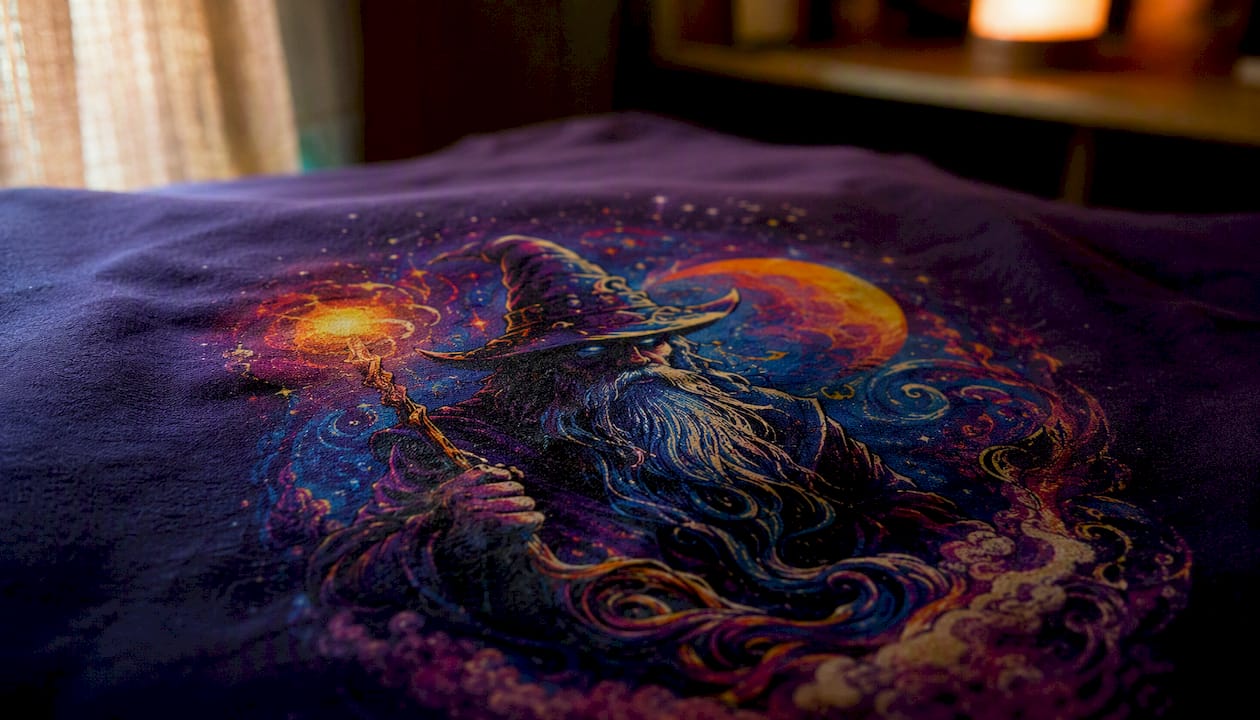
DTG handles photographic detail, smooth gradients, and unlimited colors natively. The printer reads the file the same way a desktop inkjet reads a document: every pixel is reproduced. For artwork with realistic shading, skin tones, or complex illustrations, DTG is the stronger technical choice. Aim for a minimum of 150 dpi at print size, with 300 dpi preferred for sharp edges and fine text.
Screen printing’s strength is the opposite: flat, bold, high-opacity color. Mesh count and color separation determine how much detail screen printing can reproduce; higher mesh counts improve fine-line reproduction, but the process still performs best on flat colors rather than photographic gradients. Pantone matching is a genuine advantage here. If brand color accuracy matters, screen printing delivers a precise, repeatable ink color that DTG’s CMYK mixing can only approximate.
Pro Tip: For screen printing, supply vector artwork (AI or EPS) with all fonts outlined and colors set to Pantone references. For DTG, supply a high-resolution PNG in sRGB with a transparent background. Sending the wrong file type to either printer is the single most common cause of proof delays. Check the 3wizardclothing t-shirt design guide for a full file-prep walkthrough.
Durability expectations and how to care for each print type
Screen printing generally outlasts DTG under heavy wash conditions. A well-executed plastisol screen print on a quality cotton shirt can last for decades with proper care. DTG prints are more sensitive to fabric type and curing quality. A properly made DTG print on the right cotton can reach roughly 30–50 wash cycles before noticeable fading in normal use, though that number drops quickly on polyester blends or with improper curing.
The most common durability failure modes:
- Incomplete cure. Both methods require heat to bond ink to fabric. Under-cured prints crack, peel, or fade after just a few washes.
- High-friction areas. Prints on collar edges, underarms, or cuffs wear faster regardless of method.
- Rough fabric texture. Heavily textured or loose-knit fabrics prevent full ink penetration, shortening print life for both methods.
Wash and care rules that extend print life for both methods:
- Turn the garment inside out before washing.
- Use cold water and a gentle cycle.
- Avoid high-heat drying; air dry or use low heat.
- Skip fabric softener, which degrades ink adhesion over time.
- Iron on the reverse side only, never directly on the print.
- Use a mild detergent without bleach or optical brighteners.
For a more detailed care routine, the graphic t-shirt care guide at 3wizardclothing covers garment-specific recommendations.
Which fabrics and garment colors work best with each method
DTG fabric requirements:
- 100% cotton is the ideal substrate. The ink bonds to natural fibers and cures cleanly.
- Cotton-polyester blends (50/50 or higher polyester) cause dye migration: polyester fibers release dye during curing, which bleeds into the ink layer and muddies colors. Some shops use specialty pretreatments to reduce this, but results are inconsistent.
- Performance fabrics (moisture-wicking, stretch blends) are generally poor DTG candidates without manufacturer-approved pretreatment.
- Dark garments always require a white underbase, adding cost and time to every piece.
Screen printing fabric compatibility:
- Screen printing works on cotton, polyester, nylon, canvas, and most blended fabrics.
- Ink opacity is controlled by ink type and mesh count, so dark garments are handled by adding an opaque white underbase layer, similar to DTG but without the pretreatment spray step.
- Stretchy fabrics require plastisol inks with stretch additives to prevent cracking during wear.
- Discharge printing (a screen-printing technique that removes fabric dye) works only on reactive-dyed cotton, not on polyester.
The fabric decision often settles the method question before quantity even enters the picture. A dark polyester jersey has one practical option: screen printing.
Environmental trade-offs between DTG and screen printing
DTG typically produces less water and chemical waste than traditional screen printing and supports print-on-demand models that reduce overproduction. Printing only what is ordered eliminates the unsold inventory that bulk production creates. Screen printing requires chemical emulsion for screen coating, solvent-based screen reclaiming, and significant water use for screen washout. At scale, those inputs add up.
That said, bulk screen printing can be a sustainability win when demand is certain. Printing 500 shirts in one press run uses far less energy and water per unit than printing 500 shirts one at a time on a DTG machine. The environmental advantage of DTG comes from avoiding overproduction, not from the printing process itself being inherently cleaner at volume.
Three questions worth asking any printer about their environmental practices:
- Do you use water-based or PVC-free inks, and how do you handle ink disposal?
- How is screen-reclaiming wastewater treated before discharge?
- Do you offer carbon-offset or sustainable shipping options for finished orders?
For more on sustainable apparel choices, the 3wizardclothing eco impact guide covers material and production considerations in depth.
How to decide which method fits your specific order
Work through these questions in order. The answer usually becomes clear by step four.
- What is the garment’s intended use and expected wash frequency? Heavy daily use (workwear, uniforms) favors screen printing’s durability. Occasional wear or a one-time event gift is fine with DTG.
- How complex is the artwork? Photorealistic images, gradients, or more than six colors point to DTG. Flat bold logos or text with fewer than six colors are screen printing territory.
- What is the fabric content and garment color? High-cotton, light-colored garments work with both. Polyester blends or dark garments on a tight budget push toward screen printing.
- How many pieces are you ordering? Under 24: DTG. Over 36: screen printing. Between 24 and 36: run the math on setup fees vs. per-unit DTG cost for your specific design.
- Do you need specialty ink effects? Foil, puff, metallic, or discharge: screen printing only, full stop.
Questions to ask your printer before placing the order:
- What is your minimum order quantity for screen printing?
- Do you charge for the white underbase separately on dark DTG garments?
- What ink type do you use (plastisol, water-based, discharge)?
- Can I see a sample or physical proof before the full run?
- What is your expected wash life for this print on this fabric?
Red flags that should trigger a test print or a method switch:
- Artwork with fine hairlines under 1 pt for screen printing (likely to fill in or drop out)
- Garment fabric is more than 50% polyester and the order is going to DTG
- Design requires a Pantone-accurate color match and the shop only offers DTG
- Specialty finish required but the shop only runs DTG
Pro Tip: Always request a physical sample on the actual garment color and fabric before committing to a full run. A $15–$30 test print can prevent a $300 reprint. For screen printing, ask the shop to store your screens if you plan to reorder — that waives setup fees on future runs and significantly improves the economics.
What we’ve learned choosing between DTG and screen printing at 3wizardclothing
The question we get most often from customers is some version of: “Which is better?” The honest answer is that neither method is better in the abstract. They solve different problems.
At 3wizardclothing, the graphic apparel we carry leans heavily on detailed, expressive designs: nerdy illustrations, sassy slogans, Halloween artwork with fine linework and color gradients. For that kind of art, DTG is the natural fit for small and personalized runs. The detail reproduction is simply better than what a six-color screen print can achieve on a complex illustration, and the ability to print a single piece without a setup fee makes on-demand retail viable.
Screen printing earns its place when a design is bold and simple and the order is large enough to absorb setup costs. A clean two-color logo on 50 hoodies is a screen printing job, not a DTG job. The print will be more opaque, more vibrant, and more durable under repeated washing.
The practical rule we follow: DTG for small, photo-heavy, or personalized runs; screen printing for larger runs with simple color counts or specialty ink requirements. When in doubt, request a sample. A test print on the actual garment is worth more than any spec sheet.
The care side matters as much as the print method. A great DTG print on a shirt that gets washed inside-out in cold water will outlast a mediocre screen print that goes through a hot dryer every week. Method choice and care habits together determine how long a print actually lasts.
Sources
- DTG vs. Screen Printing: Factors to Consider for Your Brand (2025) - Shopify
- DTG Printing vs Screen Printing: Cost, Quality & Durability - Apex Workwear
- DTG vs. Screen Printing | Pros, Cons, How Much It Costs - Printavo


